Ron(Rongyu) Lin | Quinnipiac University
Tenure-Track Assistant Professor of Computer Science at School of Computing & Engineering, Quinnipiac University. rongyu.lin@qu.edu

Ron(Rongyu) Lin
Principal Investigator
CCE 233
School of Computing & Engineering
Quinnipiac University
275 Mt. Carmel Ave.
Hamden, CT 06518, USA
rongyu.lin@qu.edu
I am Ron (Rongyu) Lin, a tenure-track Assistant Professor of Computer Science in the School of Computing & Engineering at Quinnipiac University.
I received my Ph.D. in Electrical and Computer Engineering from King Abdullah University of Science and Technology (KAUST) and an MBA with a STEM concentration in Data Science and Business Analytics from Santa Clara University, and I am currently pursuing a Doctor of Education at Johns Hopkins University. Before joining Quinnipiac, I was a Visiting Assistant Professor of Computer Science at Clark University; before entering academia, I was a Principal Data Scientist at Capital One, where I built valuation models for the auto loan portfolio.
My research develops artificial intelligence methods for scientific discovery, with semiconductor materials and devices as the central application. Beyond semiconductors, my research also spans AI for healthcare, LLM multi-agent simulation of marketing and consumer behavior, and energy-efficient AI systems:
- AI for Semiconductor Materials and Device Design: Machine learning and physics-based simulation for wide-bandgap devices, including III-nitride tunnel junctions, AlGaN deep-ultraviolet LEDs, GaN/AlGaN heterostructure transistors, and β-Ga2O3 thin films and photodetectors, combining TCAD simulation with machine learning surrogate models. For two-dimensional materials, property prediction and first-principles calculation, automated identification of exfoliated flakes, and modeling of 2D memristors and graphene diodes. Current work develops multi-fidelity and LLM-agent frameworks that link atomic-scale prediction, device simulation, and experimental characterization for automated device design.
- Multimodal AI for Medication and Drug Recommendation: Interpretable, multimodal models that combine patient records, molecular structure, and drug-drug interaction knowledge to recommend safe and effective medications.
- LLM Multi-Agent Simulation for Marketing and Consumer Behavior: Generative agents that simulate consumer decisions, social interaction, and marketplace dynamics to test marketing strategies before deployment.
- Energy-Efficient AI Systems: Reducing the energy consumption of foundation models and agentic AI across the stack, from hardware and system architecture to agent orchestration and harness design, model fine-tuning, and smaller, more efficient models.
My work has appeared in venues including Nature, Nature Communications, Materials Science and Engineering: R: Reports, Journal of Materials Chemistry C, ACL, and IEEE conferences. I serve on the program committees of AAAI, IJCAI-ECAI, and IEEE ICEBE, as a guest editor for special issues of MDPI Electronics and Computers, and as a reviewer for journals including Nature Electronics and IEEE Transactions on Fuzzy Systems.
I am looking for highly motivated students who are interested in AI for semiconductor materials and device design, and in the broader applications above. If you are passionate about developing machine learning frameworks for scientific discovery, please email me your CV and research interests.
I am open to research collaborations and discussions. Please feel free to reach out via email!
Our Research Group
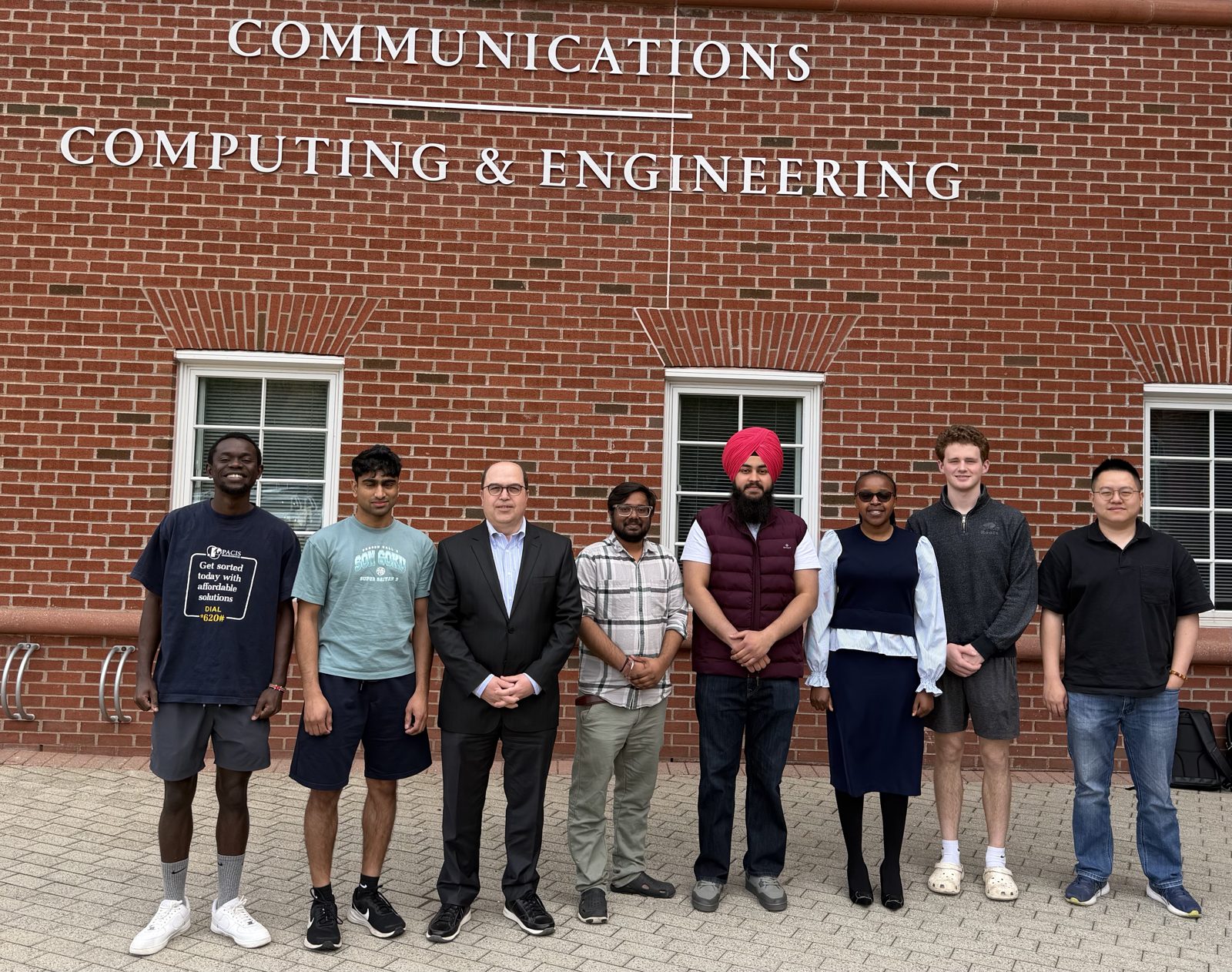
Our research group at Quinnipiac University, Spring 2026
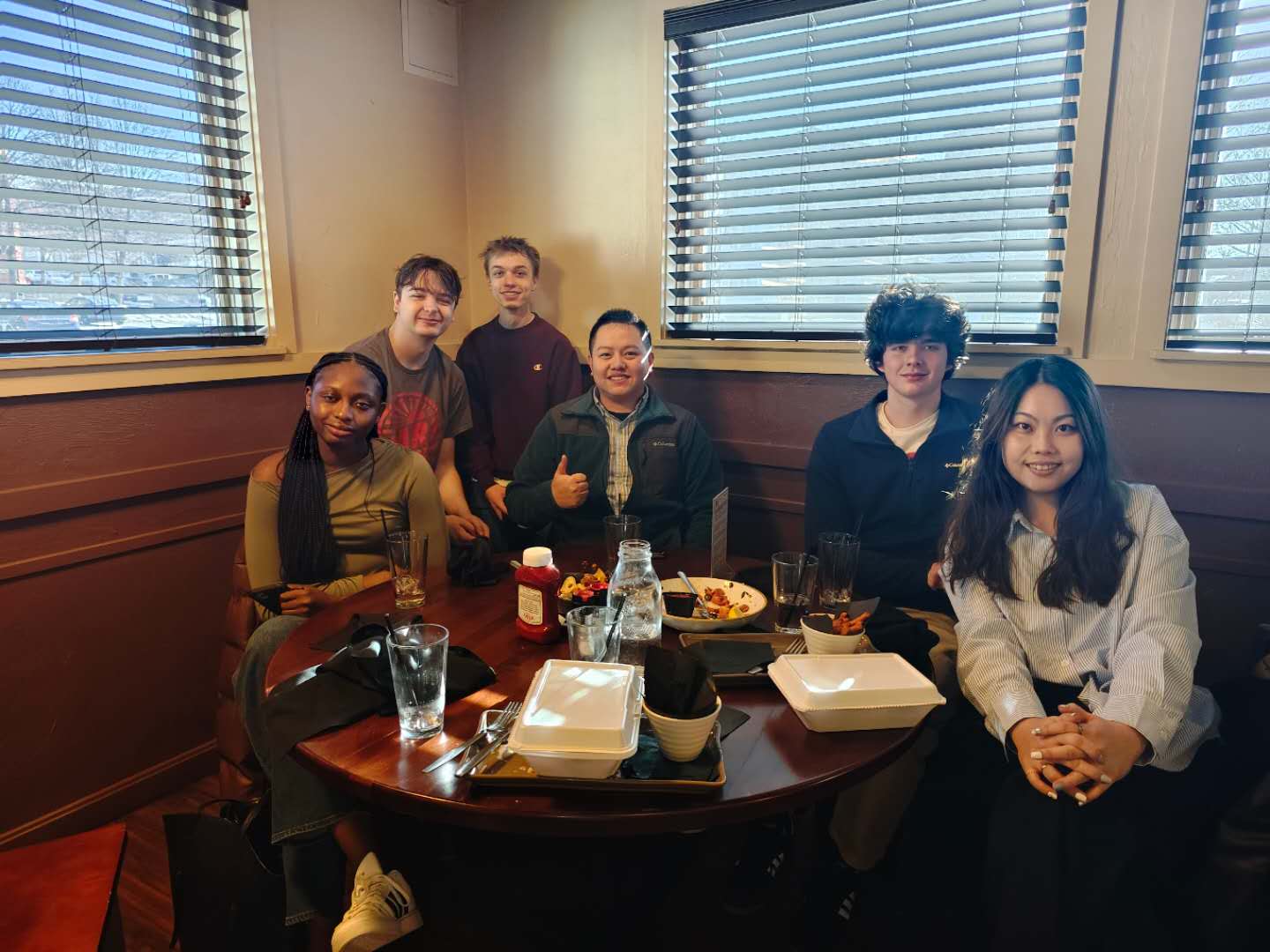
Our research team
News
| Sep 29, 2026 | 📄 Our review “Energy-Efficient AI for Foundation Models: Algorithms, Hardware, and Data Center Infrastructure” is now published in Computers 15(10), 660. Thank you to our Quinnipiac student co-authors Koushik, Ranjot, Hellen, Nirmit, Alex, and Moses, and to Dean Taskin Kocak. |
|---|---|
| Sep 18, 2026 | 🎉 Our review “Energy-Efficient AI for Foundation Models: Algorithms, Hardware, and Data Center Infrastructure” has been accepted for publication in Computers (MDPI)! Congratulations to our Quinnipiac student co-authors Koushik, Ranjot, Hellen, Nirmit, Alex, and Moses, and to Dean Taskin Kocak. |
| Sep 14, 2026 | 🎉 Exciting news! Three papers from our group have been accepted to IEEE ISAIA 2026 (Montclair, NJ, October 9–10)! Congratulations to the teams on HERO-S: QPU-Aware Energy-Latency Orchestration for AIoT Intrusion Detection, Comparative Study of Feature Dimensionality and Model Capacity in Earthquake Forecasting, and MAVIS: A Visual LLM Multi-Agent System for Marketing Analysis of Advertisement Campaigns in an AI Village. |
| Sep 05, 2026 | 🧪 Our lab has been approved for the Claude Team Plan for Scientists from Anthropic, which will support our students’ research on AI for scientific discovery. |
| Sep 05, 2026 | 🤝 Our joint project with Óbuda University, Energy-Optimized Adaptive Lighting System for Agriculture, has been funded by the QU-OU Joint Research Grant! |
| Sep 01, 2026 | 💻 Our lab secured a donated one-year academic license of Synopsys EDA software, including Sentaurus TCAD, through the Synopsys Academic & Research Alliances (SARA) program. These tools will support our research on AI for semiconductor device design and simulation. |
| May 20, 2026 | 📄 Our student-led paper “wRIST: Robotic Intermediate Sign Translator for Humanoid Robot Speech-to-Sign Language Translation” has been published in the 2026 IEEE World AI IoT Congress (AIIoT)! Congratulations to the Quinnipiac student team and our collaborators Prof. Chetan Jaiswal and Prof. Cameron LaMack. |
| Sep 15, 2025 | 📄 Our comprehensive review “Machine learning for 2D material-based devices” has been published in Materials Science and Engineering: R: Reports (Impact Factor: 31.6)! This work explores the transformative role of machine learning in advancing two-dimensional materials research and device development. |
| Aug 15, 2025 | 🎉 Exciting news! Our correspondence “Don’t train medical AI on patients’ data without their knowledge” has been accepted for publication in Nature ! Congratulations to Toral! |
| Aug 01, 2025 | 🎓 Exciting news! I’ve joined Quinnipiac University’s School of Computing & Engineering as an Assistant Professor. I’m thrilled to be part of the newly launched Informatics programs specializing in Healthcare, Law, and Data Science, with exciting collaborative opportunities between the Schools of Computing, Law, and Medicine. |
| Jun 10, 2025 | 🎉 Welcome Toral Banerjee, our new undergraduate research assistant! We’re excited to have you join our research team. |
| May 07, 2025 | 🎉 Welcome Tom Ni, our new undergraduate research assistant! We’re excited to have you join our research team. |
| Mar 17, 2025 | 🎉 Thrilled to welcome three new undergraduate researchers to our lab: Lucian Terhorst, Samar Khoso, and Matthew Zaluski! Looking forward to their contributions to our research projects. |
| Mar 10, 2025 | 🎉 Excited to announce I’m guest editing a Special Issue on “Trends and Applications of Distributed Artificial Intelligence (AI) and Associated Systems” for the MDPI journal Electronics! Interested in contributing? Check out the Special Issue page for more details. Submissions welcome! 📚🤖 |
| Jan 01, 2025 | 🎯 Currently serving as Assistant Professor of Computer Science at Quinnipiac University, focusing on AI/ML applications in semiconductor design and computational materials science. |
| Nov 24, 2024 | 🎉 Excited to welcome Kendall, an undergraduate researcher, to our group! |
| Nov 07, 2024 | Excited to be a collaborator on “Abstract2Appendix: Academic Reviews Enhance LLM Long-Context Capabilities”, now available on arXiv! 🤝 Our work explores how academic peer review data can enhance LLMs’ long-context capabilities. 📚 |
| Sep 27, 2024 | 🎉 Excited to welcome Kadin, an undergraduate researcher, to our group! He will be working on Applied AI applications in semiconductor devices. |
Selected Publications
-
 Energy-Efficient AI for Foundation Models: Algorithms, Hardware, and Data Center InfrastructureComputers, 2026
 - wRIST: Robotic Intermediate Sign Translator for Humanoid Robot Speech-to-Sign Language TranslationIn 2026 IEEE World AI IoT Congress (AIIoT), May 2026
- HERO-S: QPU-Aware Energy-Latency Orchestration for AIoT Intrusion DetectionIn 2026 IEEE International Conference on Intelligent Systems and Interdisciplinary Applications (ISAIA), Montclair, NJ, Oct 2026Accepted, to appear (EasyChair ID 112)
- Comparative Study of Feature Dimensionality and Model Capacity in Earthquake ForecastingIn 2026 IEEE International Conference on Intelligent Systems and Interdisciplinary Applications (ISAIA), Montclair, NJ, Oct 2026Accepted, to appear (EasyChair ID 120)
- MAVIS: A Visual LLM Multi-Agent System for Marketing Analysis of Advertisement Campaigns in an AI VillageIn 2026 IEEE International Conference on Intelligent Systems and Interdisciplinary Applications (ISAIA), Montclair, NJ, Oct 2026Accepted, to appear (EasyChair ID 125)
- LLM-Based Multi-Agent System for Simulating and Analyzing Marketing and Consumer BehaviorIn 2025 IEEE International Conference on e-Business Engineering (ICEBE), Nov 2025
- Machine learning for 2D material-based devicesMaterials Science and Engineering: R: Reports, Sep 2025
- Don’t train medical AI on patients’ data without their knowledgeNature, Aug 2025
- Abstract2Appendix: Academic Reviews Enhance LLM Long-Context CapabilitiesarXiv preprint arXiv:2411.05232, Aug 2024
- Multi-modal preference alignment remedies degradation of visual instruction tuning on language modelsProceedings of ACL, Aug 2024
- High-performance van der Waals antiferroelectric CuCrP2S6-based memristorsNature Communications, Aug 2023
- A machine learning study on superlattice electron blocking layer design for AlGaN deep ultraviolet light-emitting diodes using the stacked XGBoost/LightGBM algorithmJournal of Materials Chemistry C, Aug 2022
- BAlN alloy for enhanced two-dimensional electron gas characteristics of GaN/AlGaN heterostructuresJournal of Physics D: Applied Physics, Aug 2020